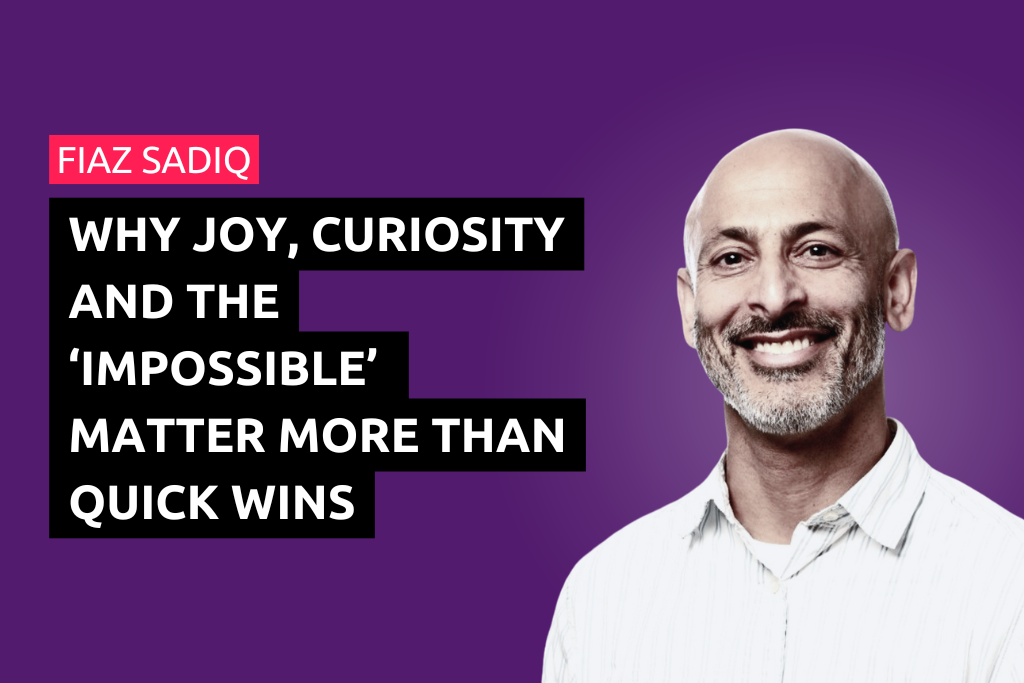
Why Joy, Curiosity and the ‘Impossible’ Matter More Than Quick Wins For Sweat Equity
EntrepreneurshipMindsetSweat EquityFor over 25 years, Fiaz Sadiq has built, scaled and exited several ventures, while coaching thousands of SMEs at different stages of growth.
When we sat down with him, the first thing he wanted to talk about wasn’t investment, valuations or product roadmaps.
It was fear.
For Fiaz, the rapid rise of AI has triggered a familiar human response: anxiety. Where many react with resistance, he sees this moment differently, comparing it to the early days of dial-up modems, the first computer mouse, or the clunky beginnings of online video.
“If you’ve got a problem or a solution you’ve been sitting on, you’ve now got a hundred employees, a hundred scientists at your fingertips,” he explains. “You can put a prompt in and get that. We didn’t have that 25 years ago. You’ve now got the stepladder to supercharge your mind.”
His advice though isn’t simply to move faster.
It’s to slow down first.
“If we take the time to slow down, to become smooth, then accelerate… that’s where our power is,” he says. “We’re in a phase right now of understanding the velocity of what’s coming, and the fear around it. But let’s just slow down and remember that, as human beings, we are remarkable.”
It’s a theme that runs through his entire worldview, to slow down, breathe, gather clarity, and then accelerate with purpose.
From there, our conversation turned to where that perspective began, a small village in Kashmir. At the age of four, Fiaz migrated with his family to Bradford, UK. His father spoke very little English, but he understood something deeper about connection and resilience even in an often hostile environment.
“When kids kicked a ball into our garden, he’d throw it back with a joke,” Fiaz recalls. “He taught me that actions open doors, even when words can’t.”
One pivotal moment came when Fiaz was nine years old, he wanted to play basketball with a group of older, taller boys. His father encouraged him with a simple phrase. ‘If you don’t ask, you’ll never know.’ This became a quiet mantra for him.
“I got pretty good at basketball, and about a year later I was still playing in pumps and wanted a pair of Converse basketball boots. My father said, ‘Let’s go take a look.’ He was very clever with his words.”
He remembers the bus ride into Bradford town centre vividly — trying the shoes on, loving the smell of them, imagining they were finally his.
“He took them to the counter and said to the woman, ‘We’re not getting them today, but we’ll be back.’”
They got back on the bus.
“I was crest-fallen. My father didn’t say a word. He always let us sit with our emotions.”
His father took him straight to the local newsagent, where he had already arranged a paper round.
“‘In six-weeks time, you’ll have half of the money for the shoes,’ he said, ‘and I will put the other half in.’ That was the best lesson of my life.”
The paper round went on to spark a Sunday market stall and with it, a sharp instinct for enterprise.
That lesson resurfaced years later, as he was finishing university and applying for his first professional roles. One application took him to Citibank. When he arrived for the interview, he was surprised to discover that the hiring manager was the father of twin girls he’d once played basketball with back in Bradford.
The connection wasn’t luck. It was the result of showing up, again and again, in different rooms, at different stages of life.
The same willingness to ask, to act, and to follow through was an early reminder that progress rarely comes from a single break. It comes from movement, from saying yes, doing the work, and trusting that small decisions compound over time.
Beyond the Instagram Version of Entrepreneurship
We see the TechCrunch headlines, the billion-dollar exits, the overnight success stories. What we don’t see are the years of grinding, the failed attempts, the countless ‘nos’ before that one transformative ‘yes’.
Fiaz calls it ‘living through Instagram eyes,’ a superficial view of entrepreneurship that mistakes visibility for progress and is setting founders and sweat equity investors up for disappointment. Too often, freelancers expect equity to deliver overnight success. But behind every headline are years of grind, false starts and failed experiments, before a single breakthrough.
“We see the good stories. We don’t see the hundred decisions that came before. Equity has become this fantasy of quick wins. But real work takes time, curiosity and honesty.
Why Should I Be Excited About This With You?
Most people think when you go for investment, it's about money. But actually, it's the contacts they have, the knowledge they have, the networks they have. That's what sweat equity can provide."
When a founder asks him to join their journey, he starts with a disarming question:
‘Why should I be excited about this with you?’ It’s not a challenge. It’s a levelling tool.
Founders often present new ideas with the giddy excitement of a child showing off a new toy. He wants something deeper. He listens for: clarity about the problem, grounded purpose, humility, and the magic word: help.
“The key trigger for me is when someone says: ‘I know this is big, and I need help along the way.’ If you don’t need help, you’re not really listening.”
Before the conversation even happens, he runs a quiet checklist in his head:
-
Do our values align?
-
Can I genuinely help this person?
-
Will they use the support I give?
-
Do they have the capacity to change, not just manage?
Betting on the Impossible
Here’s where Fiaz’s approach gets really interesting. He actively seeks out the projects that everyone else thinks won’t work.
“Those are the ones I’m really interested in. The left field ideas. It’s like the Black Eyed Peas singing when everybody else was doing Britney.”
He tells the story of one of his early investments, where he met a WiFi technician at a college where steel-framed walls blocked signals. The physics department told him that getting a frequency through the walls was impossible.
But he believed otherwise.
“I said: show me — like you’re breaking into a bank and dodging the lasers, show me that signal going through the other side of the wall and you've got my attention. Lo and behold, he demonstrated it and it worked. The secret? Copper slug tape (yes, the stuff used in gardens) placed strategically inside buildings.”
For Fiaz, it’s a reminder that breakthroughs often start with someone willing to demonstrate possibility rather than defend it. It’s a lesson for founders who find themselves waiting for perfect conditions instead of engaging with reality.
The lesson for sweat equity investors? Don’t just chase the obvious opportunities. Some of the most meaningful breakthroughs come from backing people others are quick to dismiss.
Cathedral Thinking in a World That Rewards Speed
Most freelancers think tactically: this project, this month, this quarter. Equity partnerships require what Fiaz calls cathedral thinking, building something that will matter in the long-term.
“I’m looking at a road map of at least two to three years because I’m really going to get to know them. I know full well that this might never pay off, but what I do know is I’ve helped them create something. And in the process, I’ve learned something.”
Cathedral thinking doesn’t mean waiting for perfection. In fact, it depends on movement.
“I’m not interested in the perfect product. What I’m interested in is an output.”
Fiaz has little patience for ideas that stay trapped in planning mode. Shipping something, even if it’s rough, creates momentum. It shows whether a founder can move from vision to execution, adapt when things break, and keep going when reality pushes back.
For freelancers considering sweat equity, this becomes a crucial lens. Can this founder ship something in six months? Can they fail fast, learn quickly, and iterate? Those signals matter far more than polished decks or flawless pitches.
This long-term, output-led mindset is what separates equity partnerships that grow from those that stall and what protects people from mistaking potential for progress.
Boundaries Protect the Dream
“Having boundaries creates safety for everybody,” Fiaz says. Just like we teach children not to touch fire, equity partnerships need clear limits. Agreements, expectations, and regular check-ins create the trust that allows creativity to thrive.
Fiaz has a distinctive way of thinking about alignment in equity partnerships:
“Could this DNA mix into something beautiful, or are we gonna need an antibiotic?”
He describes partnerships in terms of shared values and decision-making, recalling a social-impact platform he once supported. Midway through the journey, investors pushed to introduce gamification features he felt crossed an ethical line.
Sometimes, the DNA is a good fit, values, purpose and judgement working in harmony. Sometimes, something shifts. The key is recognising which one you’re dealing with, and having the courage to walk away when alignment is lost.
Joy is a dividend.
What keeps him doing this work after decades of risk, reinvention and mentoring?
It’s not equity payouts.
Not valuation bumps.
Not titles or roles.
“I still get that inventor’s joy,” he says, “Joy is the dividend that should never be deferred.”
For Fiaz, it’s the spark he sees when someone discovers the art of the possible and steps into it. The real return on sweat equity? The thrill of building alongside founders, spotting innovation in unlikely places, and learning through the journey.
As an advisor for Innovate UK, Fiaz pours his energy into supporting the UK’s most inventive companies.
“Giving back is a joy,” he says simply.
From launching ventures to contributing to innovation projects with organisations like Microsoft, LG and Intel, and coaching thousands of SMEs, Fiaz has seen almost every side of the entrepreneurial journey. What stands out most are not the boldest ideas, but the people behind them, those who are willing to learn, adapt, and stay aligned with their values when things get uncomfortable.
For founders, his advice is grounded and practical. Build before you polish, ask for help early, and be honest about what you don’t yet know. Momentum comes from action, not certainty.
For those considering sweat equity, the lesson is just as clear. Look beyond the pitch. Pay attention to behaviour, to boundaries, and to how someone responds when reality sets in. Long-term partnerships are shaped less by potential than by how people show up over time.
The child who once delivered newspapers to earn half the money for his first pair of Converse is now helping shape the next generation of tech innovation.
For Fiaz, equity has never been about chasing returns. It’s about the joy of building, especially when others doubt it. It’s about playing the long game, choosing to build early and trusting that meaningful work compounds over time.