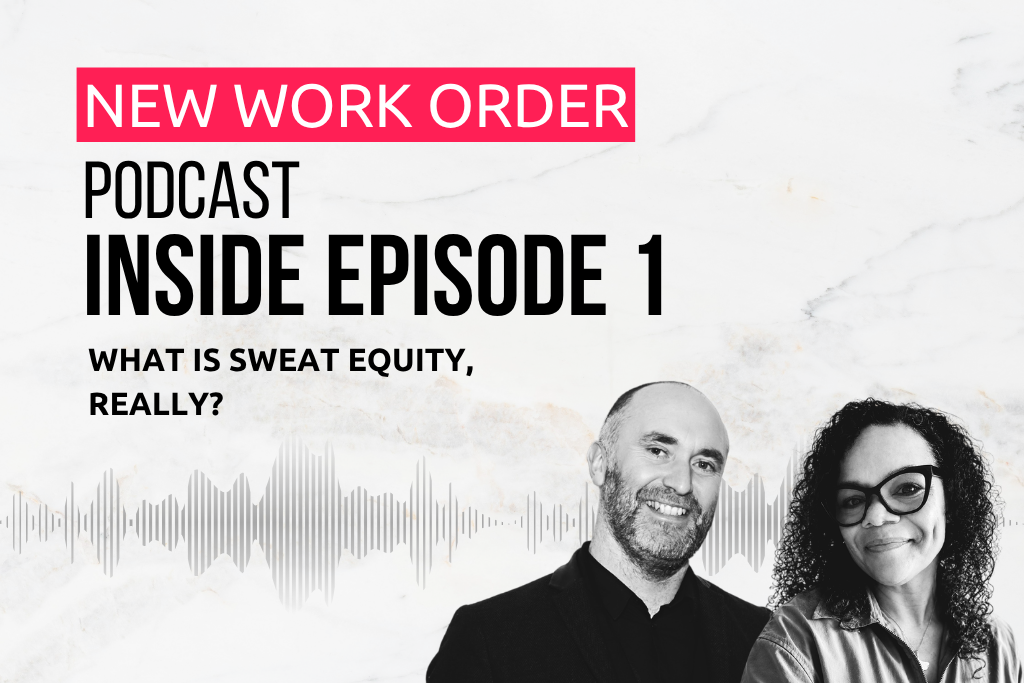
What Is Sweat Equity, Really? Inside Episode 1 of New Work Order
New Work Order PodcastTalent ResourceThere's a quiet anxiety running through a lot of career conversations right now. Pensions look thinner than the ones our parents retired on. Wages aren't keeping pace with the cost of living. The old deal — work hard, climb the ladder, retire comfortably — doesn't feel like it's holding up its end of the bargain anymore.
That's the territory New Work Order, a new podcast from Graeme Goulden and Mickela Sonola, sets out to explore. Episode one tackles a phrase that's been circulating a lot lately without much clarity behind it: sweat equity.
So what actually is sweat equity?
Strip away the jargon and it's simple: instead of investing cash into a business, you invest your skills, time, and experience. As Mickela puts it on the episode, it's "nothing new at all" — it's a long-standing part of the startup ecosystem, it just tends to only make headlines when something's gone wrong.
The mechanism is straightforward. The reframing is what's interesting: sweat equity treats your time and expertise as a form of capital. You're not just doing unpaid work — you're taking a position in something, with the risk and the potential upside that implies.
Why this conversation is happening now
Graeme and Mickela land on a few forces driving the shift:
The traditional contract has frayed. The nine-to-five-then-retire path assumed a kind of stability — one job, one income stream, a pension that would actually cover retirement — that increasingly doesn't match reality. As Mickela puts it, people are watching the generation before them get a pension deal that worked, while their own version of that deal quietly erodes.
Visibility has changed the game. Founders, freelancers, and portfolio careers are simply more visible now than they were even ten years ago. Seeing other people build something non-traditional makes it feel possible in a way it didn't when the only model on offer was "get a degree, get a job, stay there."
Diversification isn't just a finance term anymore. Graeme draws a direct line to investment strategy: you wouldn't put all your money into one stock, so why put all your working life into one employer? A portfolio career — a mix of contracting, freelancing, and sweat equity ventures — spreads that risk. Some bets won't pay off. But it only takes one or two to be genuinely worth it.
The case for working with equity instead of for a wage
Both hosts have skin in the game here — they're both invested in Sweqlink, a Manchester-founded platform built around exactly this model: matching startups with talent willing to trade time and skills for equity, rather than (or alongside) cash.
What's notable is what they emphasise as the real return, even when the equity itself never converts to anything. For Mickela, it was never really about the money. It's been about what the experience did to her craft and her discipline as a freelancer. Graeme points to the same thing from a different angle: working lean inside a startup forces a kind of creative problem-solving that a comfortable, well-resourced role rarely does.
That's the underrated case for sweat equity: even in the scenario where the venture doesn't work out, you walk away with sharper skills, a track record, and a story for the next interview — or the next venture.
A platform problem as much as a mindset problem
One of the more practical threads in the episode is about access. If you're a university student who's interested in, say, blockchain development, how do you actually find your way into a sweat equity opportunity? What does a fair equity split look like? What about NDAs, or the legal mechanics of a non-exec director role?
This is where Sweqlink positions itself as more than a matchmaking tool — the ambition, as the hosts describe it, is to arm people with the actual knowledge needed to navigate equity agreements, not just the introductions. But this isn't an abstract conversation. With food bank use rising among university students, many people aren't exploring alternative career paths out of curiosity — they're doing it because they can't afford not to. Financial necessity and career reinvention often look identical from the outside.
What's next
The episode wraps by setting up the series' next thread: real stories from people who've actually taken the sweat equity route — successes, near-misses, and the unglamorous middle parts. If episode one is the framework, the rest of the series is clearly going to be the evidence.
A New Work Order is hosted by Graeme Goulden and Mickela Sonola. Episode 1 — "What Is Sweat Equity, Really?" is out now.
Listen here or wherever you get your podcasts