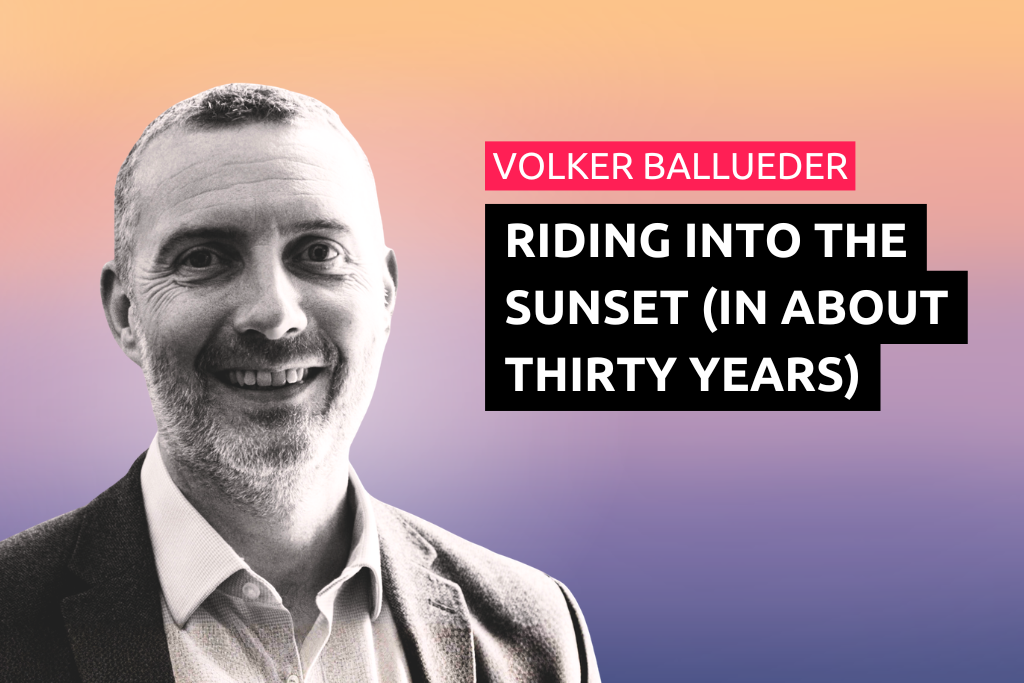
Riding Into the Sunset (In About Thirty Years)
Talent ResourceEntrepreneurshipVolker Ballueder has been made redundant more times than most of us change jobs. Instead of climbing back onto the salary ladder, he built a portfolio career spanning coaching, psychotherapy, consulting, and advisory work, alongside sweat equity stakes in the startups he believes in. Along the way he’s founded his own company, written a book, and launched two podcasts. We sat down to talk about how those deals actually work, what he looks for in a founder, and what seven redundancies teach you about resilience.
Volker’s career reads like a screenplay — and seven redundancies is the kind of detail a screenwriter would invent as the turning point. It’s why I opened our conversation with a slightly odd question: if someone made a film about your life, what would the opening scene be?
Volker laughed, admitted I’d caught him off guard (he’s planned his next book, and possibly the one after, but not the movie) and then gave me an answer that tells you everything about him.
The opening scene of my movie would probably be someone riding into the sunset, putting up their finger and going, you know what, guys? I’m done.
Before you read that as bitterness, hear him out. The finger to the sky isn’t anger. It’s the freedom of someone who has stopped waiting for permission.
He’s earned that freedom the hard way.
On paper, Volker did everything right. A first-class engineering degree. An MBA with commendation. And then he couldn’t find a job. After what felt like a hundred applications a day, he landed in telemarketing. For someone born and bred in Germany, having a master’s degree and working an entry-level job was almost inconceivable.
Psychologically, you’ve got an MBA, and you start in telemarketing. From a German mindset it was like, wait a second, I got this master’s, I should be up here.
So he started from the bottom, worked his way up, hit the ceiling fast, and went looking for the next challenge. And a pattern emerged that will be uncomfortably familiar to anyone who’s spent time in ad tech and digital media: join a company, do good work, get acquired (usually by an American buyer), wait a year for the restructure, take the redundancy.
Every time, I lost 100% of my income.
One redundancy landed three months before his first son was born. Instead of spending evenings with his wife, he was preparing for interviews. He went from the hospital into interviews.
Everything we’re conditioned to believe — that securing a job will give you security — was debunked for Volker. That’s the reality behind the tidy phrase ‘single point of failure’. When your entire income is one salary, someone else’s spreadsheet decision can take all of it. And as he points out, it’s rarely personal, because you were never really a person in that decision.
You’d be reduced to a line on an Excel sheet. That’s all you are — your initials and your salary. And you’re not a human.
The final straw came in 2019: someone he’d known and trusted for years never spoke to him directly about problems, but sent a deputy over from the US to hand him a performance improvement plan. Volker noticed it was taking a genuine toll on him, and he walked.
This time, the next challenge wasn’t another executive role. It was building something no restructure could take away.
That decision led him into coaching, something he’d been quietly drawn to since reading The 7 Habits of Highly Effective People as a student and investing in NLP training between his degrees. Now, he’s a qualified EMCC senior practitioner coach and hypno-psychotherapist. Volker admits that coaching takes years to build into a living, and the consulting and advisory work he picked up along the way is where sweat equity entered the picture.
It started organically, probably the same way it does for many people. While he’d have preferred to charge cash, most startups simply didn’t have it. So rather than walk away, he chose to take equity. This led him to the discovery that working with startups keeps him interested, keeps him engaged, and occasionally turns into real money. “It’s a bit of a bet,” he says, and he means it literally: of the handful of startups he’s put money into over the years, one went under, one is struggling, and one may well return enough to cover the rest.
The crucial part is that he’d often give the time anyway. He only works with founders he likes, on products he believes have a future, and where he thinks he can actually move the needle.
When I left the industry, I didn’t want to put all my eggs in one basket.
Today Volker works with four or five companies at once, at different income levels: paid coaching and training through his own practice, consulting, advisory roles, and equity stakes in startups. Losing a client still hurts. “It always hurts”, he says. But it no longer means losing everything. “I still have enough income to feed the family, and I think that makes a huge difference psychologically, than being dependent on just one salary.”
And the equity? “This is my bonus, if you like.”
How a sweat equity deal actually works
This is the part I was most keen to mine, because removing the mystery around sweat equity agreements is an important element of what we do at Sweqlink. And Volker, who also mentors first-time advisors, NEDs and fractionals, has a refreshingly practical formula.
Start with your day rate.
Volker has noticed that most people don’t know how to work one out, so he keeps it simple: take the income you want to earn in a year and divide it by the days you can actually work. His worked example: a £100,000 target, minus weekends and holidays, leaves roughly 200 working days, giving a day rate of £500.
Then price the risk.
If a startup can’t pay that in cash, you don’t simply take £500 worth of equity instead. “£500 in equity is obviously a lot more risky than £500 in cash. So I always say double, or maybe even triple that, depending on the stage of the startup.”
Give it structure.
Commit for at least twelve months to make it worthwhile, with vesting over a couple of years. Depending on how the company is set up, you’ll take a percentage or options.
Blend where you can.
He’s done deals that were part cash, part equity (say £250 in cash topped up with a larger equity equivalent). “Anything in between”, as he puts it. The mix keeps you paid and keeps you invested, in both senses.
And get something in writing.
More on that below.
My favourite arrangement he described didn’t involve equity at all. He was advising a tech founder whose business partner ran a social media agency, so they swapped rate cards. A pure barter deal. “People often go, oh, this is a good idea, because people don’t think of it.” It won’t work with every company, but it’s a brilliant reminder that these arrangements are only as rigid as your imagination.
The ‘get it in writing’ rule comes from experience. Early in his career, he built a startup’s presence across Europe on the promise of shares. The shares never came. When the start-up sold to a bigger player for millions, Volker never saw a penny of it; what he got instead were shares in the acquiring company, and when that company later sold at a fire sale, those proved worthless. All that work and nothing to show for it.
I was very naive early on in my career and trusted someone. I should have just got a piece of paper — got it in writing.
His rule now is nuanced rather than cynical. A genuinely scrappy early-stage startup might not have any legal paperwork yet, and that’s okay: you’re trusting the founder, and at minimum you get an email that says this is what we agreed. But a funded company, six to twelve months in, should be able to put a proper contract in front of you. He points to SeedLegals (quick to add he’s not affiliated) as making shareholder agreements easy, and platforms like FounderCatalyst do the same job, so there’s little excuse.
And if a founder resists putting it in writing? That speaks volumes.
Volker describes himself as a ‘craftsman of clarity’, so I asked: when you’re sizing up an opportunity, are you looking at the wood or the craftsman?
His answer: mostly the craftsman.
Twenty years in sales, plus his coaching and therapy work, have given him a feel for people, and his red flags are as much about the person as the pitch.
Can the founder explain the product?
“If I don’t understand it, then either I’m really stupid — which could be the case, I might just not get it — or there’s no product.”
Is the pitch too slick?
A startup that presents like a seasoned scale-up, with a polished deck, confident projections and an invest-now-price-later structure. “I’m in sales. I can make up really good numbers.” If the figures don’t back up the confidence, he walks away.
Founders who are too hesitant to take your money.
It makes him wonder whether they’re serious about the idea at all.
He also owns a personal bias, carefully. When investing money, as opposed to time, he prefers second-time founders. “They’ve done it before, they know what they’re doing. If sh*t hits the fan, they’re usually not out of their comfort zone.” He’s at pains not to dishonour first-timers (he’s one himself, of his own company), and he knows plenty of investors who love backing them. But for his own cash, prior experience buys him reassurance.
And when he’s unsure? He phones a mentor: someone far more experienced in investing, and who has already talked him out of at least one deal that went nowhere. Even his advisor has an advisor.
Volker has a healthy framing of startup investing; he is completely unsentimental about the risk involved.
I don’t remortgage my house to invest in a startup. It’s hedging your bets. It’s modern-day gambling, at the end of the day.
He recently had the chance to sell shares in one of his investments during a funding round and chose to hold, hoping to further increase the return on what he put in. He’d be delighted if it lands. But rather than getting carried away with the bright lights of what if, he stays grounded.
Until these events happen, you have nothing. On paper, it all looks great. But until the event happens, it’s worthless.
I am still in the early days of sweat equity investing myself, so I had a personal reason for my next question: what should someone watch for in themselves before committing their time or money to a startup?
Start with your values
“The main thing is that the mission and vision of the company align with your own values. Don’t invest in an arms company if you’re against wars.” If you’re putting your money and your name out there, make sure you can live with where it lands.
Slow down.
“Before you sign on the dotted line and sign your money away, have a good night’s sleep, and talk to a friend or mentor about it.”
One thing we kept circling back to was time being the real currency. It’s something I think about a lot: every hour I give one thing is an hour I’m not giving something else, and that cost is invisible until you account for it. Volker’s answer to this is characteristically pragmatic: fewer scheduled meetings, more genuine availability. One startup he advises has moved from weekly calls to fortnightly, but he’s reachable on WhatsApp in between, and if a big deal is closing at 8pm, he’s on the call at 8pm. “I have a vested interest in making this work.”
There’s a mirror image of this on the founder’s side. When a founder pays you in equity, they’re not handing over hard-earned cash; “they’re just giving away a bit of paper, if you like”. That paper only becomes worth something if the company grows, and the founder is watching to see whether you’re actually helping it grow. So your effort isn’t just how you earn the equity; it’s part of what gives the equity any value in the first place.
All those redundancies, all those moments of being a line on a spreadsheet, have fed directly into what Volker does now. He trains leaders in resilience, burnout prevention and what he calls human-centric leadership: authenticity, empathy, compassion, emotional intelligence. And he’s convinced these are about to become the most valuable skills in the room.
As AI evolves, those soft skills we have now — intuition, emotional intelligence, instinct — they’re becoming the hard skills of tomorrow. Much more important than knowing how to code.
He told me about a software developer he’d met at a conference the week before, who argued that you no longer need to program to build software: you need to be creative.
The creatives of today are the developers of tomorrow.
According to Volker, that cinematic scene from the start, him riding into the sunset, is at least thirty years away, if it ever comes, because he’s the kind of person who keeps reaching for the next challenge.
I’m just a very curious person, and I like to learn and do more things and new things.
Sweat Equity Investing, Volker Style
-
Invest in what you believe in. If the mission doesn’t match your values, walk away, however good the numbers.
-
Know your day rate. Annual target ÷ workable days. Everything else builds on this number.
-
Double or triple it for equity. Paper is riskier than cash, so price accordingly, and adjust for stage.
-
Commit and vest. At least twelve months in, vesting over a couple of years.
-
Blend or barter. Part cash, part equity, or swap rate cards if it fits.
-
Get it in writing. An email at minimum; a proper agreement once they’re funded.
-
Watch the founder, not just the deck. Can they explain the product? Too slick? Too hesitant?
-
Only bet what you can lose. No remortgaging the house for anyone’s pitch.
-
Nothing is real until the exit. Paper value is not money.
-
Sleep on it. Then phone a mentor before you sign.
-
Show up. Availability beats a fixed weekly agenda, and it’s what makes the paper worth something.
About Volker
Volker Ballueder is a former Chief Revenue Officer with twenty years in commercial leadership across ad tech and SaaS. He’s now the founder of Obnatus, where he works as an executive coach, hypno-psychotherapist and leadership trainer, and he mentors first-time advisors, NEDs and fractionals through Connectd. He’s the author of the bestselling book, Principles for Success and co-host, with David Pawsey, of Man Up / Man Down, a podcast for middle-aged men (his second, following Stories of Success, where he interviewed close to a hundred high achievers). Volker means it when he says anyone navigating redundancy or weighing up an advisory deal is welcome to reach out. Find him here.
 |
Written by Mickela SonolaCommunity Manager and Sweat Equity investor at Sweqlink, Co-host of A New Work Order Podcast |